Home/Materials
Base material & compliance

316L, PVD gold, and the nickel limits that actually apply

Material choice decides what can be promised, which suppliers can quote, and where the real risk sits. This page is the long version of what most suppliers put in one line — including the claims we deliberately refuse to make.

Scope: this page explains how we read materials and which documents we ask a factory for. It is not a compliance opinion, and nothing here is a certificate. What your market requires is decided by your market — and by your own compliance adviser where you use one. Our position is simple: 316L contains nickel, and finished-product release is product-specific, so we request the relevant supplier report when the market or the buyer requires it.
The base metal

316L stainless steel — what it is, and what it is not

Most confusion in this category comes from one sentence: 316L is not nickel-free. It contains nickel. The reason it is still the working line is a different argument, and it is worth stating properly.

  • It contains nickel. 316L typically carries nickel in the 8–12% range as part of the alloy itself — not as a coating.
  • The nickel is bound in the alloy structure, rather than sitting on the surface as a plating layer. That is why 316L is the usual choice for pierced components — but the released amount is still a measured result, not a property of the alloy name.
  • So a finished component still needs a document. 316L contains nickel; whether a finished earring passes a given limit depends on the alloy lot, the plating route and the polishing — and is confirmed by a supplier test report or declaration, reviewed before we agree to bulk.
  • That is why a nickel release report is routine, not heroic. Passing a strict limit on 316L is a normal expectation of a competent factory, not a special engineering project.
  • It is also why the report still has to be asked for. "We use 316L" is a material statement, not a test result. The test result is a separate document.
Practical consequence: if a supplier answers "our stainless steel is nickel-free", that answer is wrong on the chemistry, and it is a signal about how carefully the rest of their specification sheet should be read.
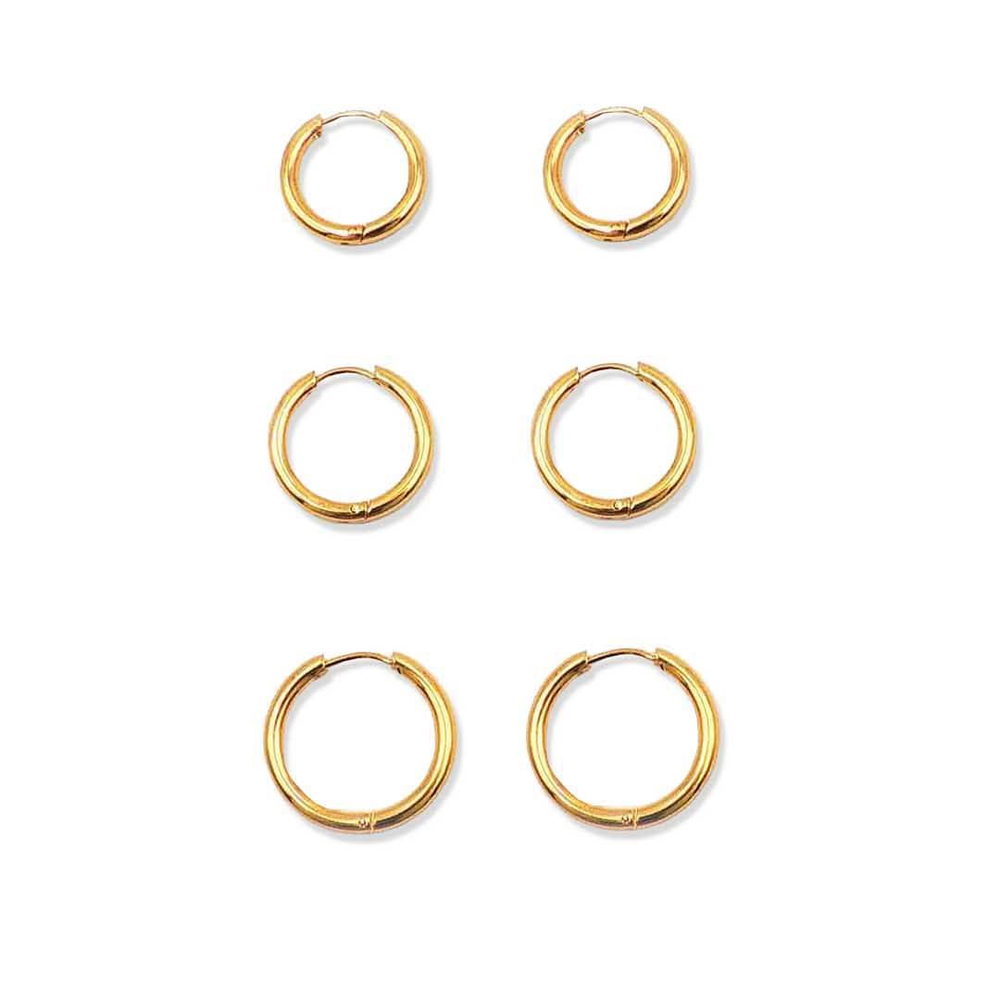
Six plain polished gold-tone huggie earrings on a plain white background
No texture and no stones — the direction where plating and finish are the whole product.
The gold layer

PVD versus conventional electroplating

Both are gold-colour layers on a base metal. They are not the same process, and the difference matters for what you can honestly say on a product page.

Aspect PVD Conventional electroplating
How the layer is formed Deposited under vacuum from a vapour phase Deposited from a liquid electrolyte bath using current
Relative wear resistance Harder layer; generally the more wear-resistant of the two Softer layer; wears faster under the same conditions
Colour control Narrower range per run, tighter consistency across a batch Wider colour range available, more drift between lots
Relevance to earrings Preferred where the piece sits in a piercing all day Common on fast-turnaround and lower entry-price work
What it does not give you Neither process is a warranty period. We describe the process, and ask for the supplier's own durability test data. We do not publish a wear-time guarantee.
Where the distinction is abused: PVD gets used in marketing as if it means the piece will not fade. A harder coating is a better coating — it is not a promise, and treating it as one is how a supplier ends up absorbing a claim they never made.
The numbers

Nickel release limits — two tiers, and the earring detail matters

There is a widely repeated simplification that "earrings are pierced wear, so the strict limit applies". The regulation is more precise than that, and being precise here changes which questions you ask a factory.

Tier Limit What it covers
Stricter < 0.2 µg/cm²/week Post assemblies — the part inserted into the pierced hole, including during the healing period.
General < 0.5 µg/cm²/week Articles in direct and prolonged contact with the skin. The entry lists the covered categories explicitly, and earrings are named in this tier.
Coated articles < 0.5 for two years Where a non-nickel coating is used, that coating must keep release below the limit for two years of normal use. This clause is what directly constrains gold-plated pieces.
Sources for the table above: EU REACH Annex XVII, entry 27 — the 0.2 / 0.5 / two-year structure and the naming of earrings are taken from the regulation text itself. China's GB 28480-2012 uses the same two tiers; an SGS interpretation table states them as non-body piercing ≤ 0.5 and body piercing ≤ 0.2. Both jurisdictions use the same numbers, so there is no regional loophole to exploit here.
China's standard is changing — this matters for your file. A replacement, GB 28480-2026 (Jewellery — Technical requirements for safety), was published on 31 March 2026 and takes effect on 1 April 2027, fully replacing GB 28480-2012 after a 12-month transition. It is a bigger change than the number suggests: the scope moves from "harmful element limits" to chemical plus mechanical and physical safety plus labelling, the old exemption for gem-set jewellery is removed, and lead limits for children's jewellery are tightened. A report issued today against the 2012 edition is still the valid one — but if a supplier has not started moving its file toward the new edition, that tells you how closely they track Chinese standard changes. We ask which edition a report is written against, and we will flag the switch as the deadline approaches.
Test method

Which version of the test

The European nickel release test method is EN 1811. A revised edition — EN 1811:2023 — was published by CEN on 22 February 2023 and superseded EN 1811:2011+A1:2015; the EU then updated the harmonised-standards list for REACH Annex XVII entry 27 on 20 December 2023. A report citing the older method is not automatically invalid, but the edition it cites tells you whether a factory's compliance file has been kept current.

United States

California Proposition 65

Soluble nickel compounds were added to the Proposition 65 list on 26 October 2018. This is a separate regime from REACH and is not satisfied by a passing EU test alone — it is a labelling and exposure question, not only a release-rate question.

Cost of testing

What a test costs

Third-party quotes collected for this type of testing ranged widely — from roughly ¥540 at the low end to ¥800–1300 from larger labs, with international quotes between $50 and $200 per sample. These are published third-party figures, not quotes we obtained. Budget ¥500–1300 per style as a planning order of magnitude.

The copper and alloy line

Where alloy is still useful, and the one rule attached to it

Copper and zinc alloy gold plating is not obsolete. It is faster to sample, cheaper to quote, and it can produce shapes that stainless steel tooling handles poorly. The rule is about where it is allowed to go.

Why the nickel problem is not in the base metal

Copper and zinc alloys themselves contain no nickel. The nickel appears earlier in the process: many plating lines apply a nickel strike layer as an adhesion base before the gold layer goes on. If that intermediate layer is present and the gold wears through, release can rise.

This is why the question is not answerable by visual inspection. An incoming QC check looks at the finished outside surface — it cannot tell you what is underneath it.

So it is a term, not a check. For anything worn in a piercing, the plating specification is agreed with the factory in writing before sampling starts — does the line use a nickel strike, can it run nickel-free, and what does that change on price and lead time.

The working rules we apply

  • Piercing wear — earrings: 316L base is the preferred route for anything inside the piercing. If copper or alloy is proposed for a pierced component, it is reviewed case by case against supplier documents, and only proceeds with a nickel-free plating specification agreed in writing.
  • Non-piercing wear — chains, pendants, rings: alloy remains an option, quoted honestly as a lower-durability route rather than dressed up as equivalent.
  • Never as an inspection item — we do not present a nickel-free claim as something verified by looking at the finished goods.
  • Always as a documented term — so that if the question is asked later, there is a written answer rather than a recollection.
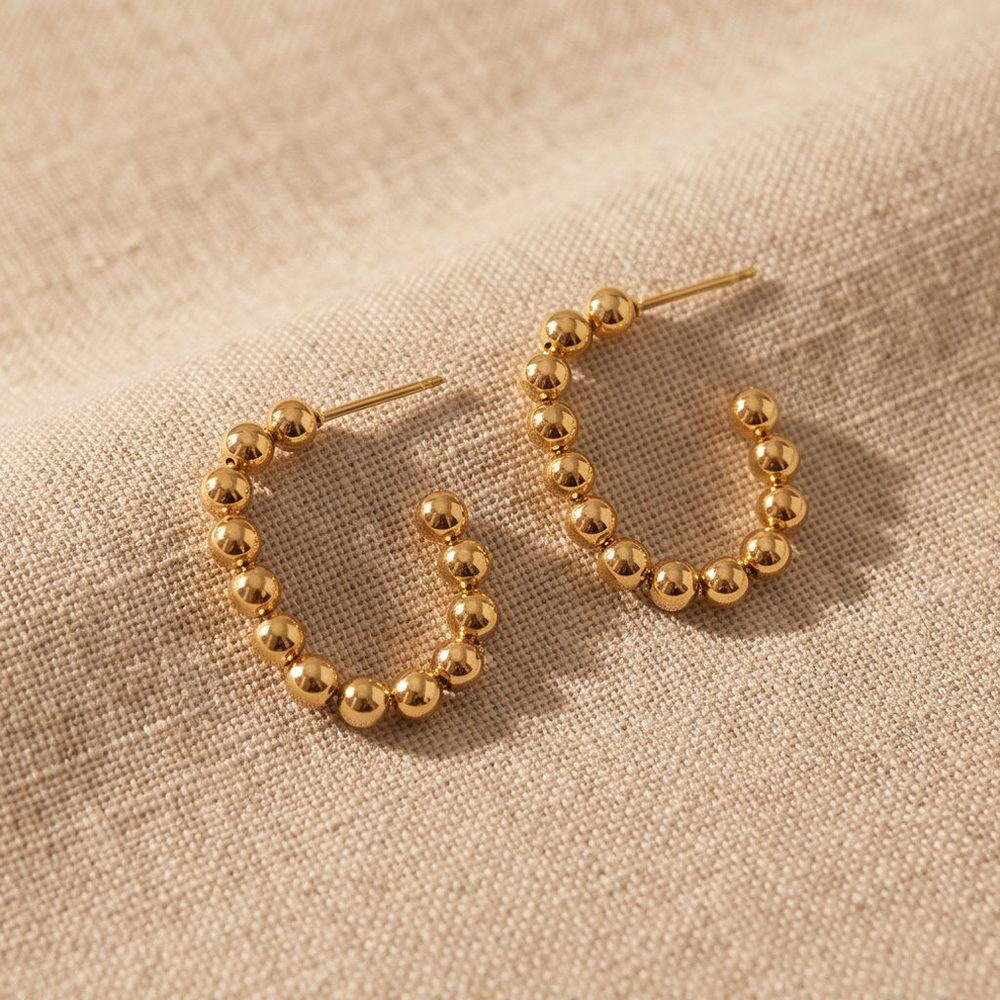
Gold-tone beaded huggie earrings with a row of small beads along the outer face
A beaded surface hides minor plating drift — a plain polish does not.
Supplier questions

Seven questions we put to a factory before sampling

These are the questions that separate a supplier with a real compliance file from one with a confident sentence. They are also the questions a buyer rarely asks, which is exactly why they are useful.

1

Which lab produced the report, and when?

A named laboratory and a date. "We have a report" without either is not an answer.

2

Which version of the test method?

EN 1811:2023 and the earlier 2011 edition are different documents. The version tells you whether the file has been maintained.

3

Does the plating line use a nickel strike?

For any copper or alloy piercing piece this is the decisive question, and it cannot be answered by looking at the finished item.

4

Can you run it nickel-free, and at what cost?

If the answer is no, that is useful information and it arrives before money changes hands.

5

Is the coating specified for two-year normal use?

The coated-article clause is a durability requirement, not only a release number.

6

Which base grade, and can you show the material certificate?

316L versus a lower grade is a material statement. The certificate is the evidence for it.

7

What changes between sample and bulk plating?

Batch size changes the plating bath. Knowing in advance which points to re-photograph is the whole point of documenting the approved sample.

Limits

Claims we will not put on a page

This list exists because it is shorter to state what is off the table than to negotiate it later. Several of these are phrases competitors use freely.

We do not claim

  • Nickel-free — 316L contains nickel. We describe release behaviour and request documents instead.
  • Warranty or wear period — no "lasts two years" or "guaranteed 12 months" statement on any process, PVD included.
  • Waterproof — no such designation exists for this category in a way we can verify.
  • Hypoallergenic — an unregulated marketing term, not a testable property.
  • Lead-free — we can request declarations; we do not certify them ourselves.

We do instead

  • Describe the material accurately, including the parts that are less flattering.
  • Request the document — lab, method version and date, in writing.
  • Report what the document says, and say so when there is no document.
  • Name the plating process and ask for the supplier's own test data rather than inventing a period.
  • Flag the gap when a claim your market needs cannot be supported for your piece.
Why this is a selling point rather than a weakness: if a compliance claim cannot be documented, the honest outcome is that you find out during sampling instead of after your customer finds out. On a pierced-wear category, the second version of that discovery is considerably more expensive.
Out of scope

Categories we deliberately do not sample

Regulatory weight

Children's jewelry

A materially heavier regime than adult jewelry — separate lead limits and additional migration testing under Chinese national standards, plus CPSIA and ASTM F2923 requirements in the United States, which typically need their own third-party testing engagement. It is not a variation on adult jewelry sampling.

Capability mismatch

Solid 14K / 18K gold

At that tier the value is in metal weight and gold price, which is a different business with different stock risk and different buyer expectations. It also removes the checking skill that matters here, which is plating and setting consistency.

Operating model

High-compliance custom programs

Northern European and German custom programs frequently require documentation and testing scope that exceeds a low-MOQ sample relationship. Better to decline than to accept an order that cannot be supported end to end.

Want the supplier questions asked on your behalf?

Send one reference and the market you sell into. We will tell you which compliance points are worth chasing for that piece, and which ones will not survive a factory conversation.