Home/How it works
The process

Four steps from reference to a bulk decision

We do not send a giant catalog and ask you to choose blindly. We start with a short reference direction, then check supplier feasibility and the risk points that affect real sample orders. Each step below says what happens, what you receive, and what has to be confirmed in writing before the next step starts.

Step 01

Reference board

Build a 2–5 style direction based on your current brand look and price band. This is the step that determines everything downstream — a wrong board produces samples that are technically fine and commercially useless.

What you send

  • One to three references: a link, a screenshot, a competitor product, or your own old style.
  • Your target retail price, even if it is a rough range. A board without a price band is guesswork.
  • Where you sell — market and channel both change what "good enough" means.
  • Anything you already know is off the table: metal, size, plating colour, closure type.

What you receive

  • A 2–5 style board with the direction for each style, and the reasoning for why it is on the board.
  • An honest read on which references cannot be made at your price band, and what the closest realistic version is.
  • Open questions listed as questions — not filled in with assumptions.
Rule we keep here: we do not guess specifications. If a field is unknown, it stays marked unknown until you confirm it. A board built on guessed specs is worse than no board.
Your input
1–3 references + price band
Output
2–5 style direction
Decided by
You
Next step gate
Board approved
Your input
Approved board
Output
Feasibility + cost read
Confirmed in writing
MOQ, fees, lead times
Next step gate
You approve sample spend
Step 02

Supplier check

Review base material, plating route, MOQ, sample fee, sample time, and bulk lead time. The purpose of this step is to find out whether the direction is actually makeable at your number — before you pay for a sample that was never going to work commercially.

What gets checked

  • Base material — brass, stainless steel, or silver. This single choice moves cost more than any other variable.
  • Plating route — thickness and process. Thin plating is where "it looked fine in the sample" turns into returns.
  • MOQ per style, not per order. A low total MOQ means nothing if each style carries its own minimum.
  • Sample fee and whether it is credited against the first bulk order.
  • Sample time versus bulk lead time — these are different numbers and are often mixed up in quotes.
  • Feasibility of your price band — stated plainly, including when the answer is no.
What we do not do: we do not quote a price we have not had confirmed, and we do not treat a verbal number as confirmed. If it is not in writing, it does not exist at this step.
Step 03

Sample follow-up

Track product photos, stone setting, finishing, clasp, ear post details, and packaging. This is where a supplier's real standard shows, because a sample is the piece they choose to send you.

What we document

  • Pre-shipment photos of the actual sample, not a catalog render, so what you approve is what arrives.
  • Stone setting close-ups for coverage, tilt, seating, and any visible adhesive.
  • Finish and polish including the ear post and the inside of the hoop, which are usually where shortcuts hide.
  • Closure and hinge — tension, alignment, and whether the post holds under normal handling.
  • Packaging as it will ship: card, pouch, box, and any insert or label.
  • Discrepancies listed explicitly — anything that does not match the approved board gets flagged, not smoothed over.
Photo limits, stated honestly: colour in photographs is affected by light source, background, and camera settings. We photograph against a consistent reference so tone drift is visible, but final judgement on a physical sample is still yours.
Your input
Sample spend approval
Output
Documented sample photos
Checked against
The approved board
Next step gate
You approve the sample
Your input
Approved physical sample
Output
Bulk photo comparison
Compared on
5 documented points
Decision
Yours — release or hold
Step 04

Bulk readiness

Compare the approved sample with bulk pre-shipment photos before release decisions. A sample that passed is not the same as a production run that matches, and this is the only step that closes that gap before money changes hands.

The five comparison points

PointWhat a mismatch looks like
Plating toneGold reads warmer or greener than the approved sample under the same light.
Stone settingRows looser, gaps wider, or stones sitting higher than the approved piece.
Surface and polishNew scratches, tool marks, or an unpolished ear post that the sample did not have.
Closure and fitHinge tension softer, or the post needing more force to seat than the sample did.
PackagingDifferent card, missing insert, unreadable label, or packing that will not survive transit.
Where the boundary sits: we document and compare. We do not certify compliance claims, we do not grade stones, and we do not release an order on your behalf. The release decision stays with you.
Who does what

Clear division, so nothing waits on a misunderstanding

StepYouWe handle
1 Reference board Send references and price band; approve the direction. Build the board, flag what is not makeable, list open questions.
2 Supplier check Decide whether to spend on samples. Get MOQ, plating route, fees and lead times confirmed in writing.
3 Sample follow-up Judge the physical sample; approve or send back. Chase the supplier, document photos, list discrepancies.
4 Bulk readiness Make the release decision. Compare bulk photos against the approved sample, point by point.
Lead times are not quoted on this page on purpose. Sample time and bulk lead time depend on the style, the plating route, and the supplier's current queue, and a number published here would be wrong for most projects. They are confirmed per project in step 2.
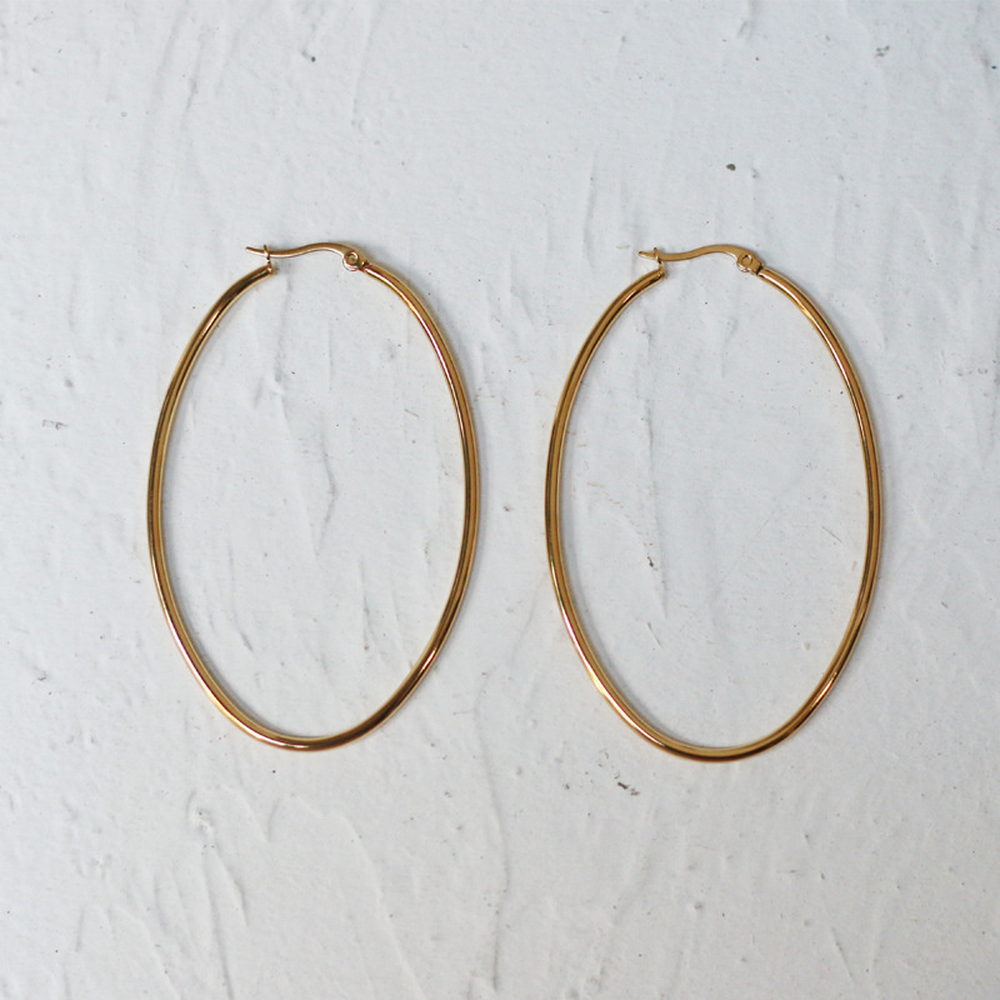
Two large thin gold-tone hoop earrings standing against a pale stone surface
Step four compares what actually ships against the sample you approved — on the same points, in the same frames.

Start with step one — it costs you one reference

Send a reference and your target retail price. You will get a direction and an honest read on what is realistic.